13 Myths of Plastic Recycling
The plastics industry has mythologised recycling to make a toxic industrial process seem progressive
Myth 1: “Recycling works for plastics.”
‘Recycling’ implies that something has a ‘cycle’ - that it cycles round and round undergoing changes but comes back to an original state. Some materials do cycle around, but synthetic plastic does not. Plastic is only ever processed into lower grade material. Often after just one reprocessing, sometimes a few more, plastic becomes toxic waste.
The deliberate choice by the plastics industry to call the reprocessing of plastic ‘recycling’ lends to the illusion that it is a cycle. 'Recycling' should accurately be called down-processing: making new objects out of degraded materials.


Myth 2: “If plastic is ‘recycled’, it’s no longer a problem.”
Recycled plastic is more toxic and less stable. All plastic goes on to become toxic waste and pollution of some kind or another. It can be recycled once, or in rarer cases a few times, but then what? The recycling process may delay the entry of some of the material into the waste stream, but this is just a delay - it still goes on to become waste which pollutes natural systems and affects human, animal, marine and soil health.
As long as we keep recycling, we will keep producing new plastic.
Usually, this statement goes alongside a claim that 90% of plastic has been incinerated, landfilled, or is in land, water, or air right now. Nevertheless, it presents a more hopeful version of reality. 10% is not much, we may think, but at least it is something. The impression we get is that 10% is now dealt with - ‘recycled’ - done. Therefore, we may say, we just need more progress, and to increase 'recycling' rates. But as we have seen, anything that has been ‘recycled’ still has to be dealt with because it has no place in natural cycles. That 10% is not finished with, it just went through one down-processing event. That 'recycling' also made it more toxic and more fragile.
Recycling is not a destination. It is a delaying tactic and the material will still end up as waste. Plastics recycling cannot solve the plastics crisis.


Myth 3: “Less than 10% of plastic has ever been recycled: the rest is waste.”
This myth is repeated by well-meaning anti-plastics advocates
Myth 4: “Recycling isn’t perfect, but it reduces pollution.”
Recycling just delays throwing the material away. The processes cause the direct release of toxic micro- and nano- particles into the air and groundwater. This kind of pollution is everywhere, and recycling worsens it. It can pass biological barriers, entering our blood and all our major organs. ‘Recycled’ plastic products are more chemically complex and more fragile, and therefore give off higher amounts of more toxic particles.
This would be a problem even if ‘recycling’ was happening while plastic production slowed down. But it isn’t – it’s increasing. The illusion that recycling works is enabling further production. But it also necessitates more production: recycled products often require additional new plastic. All of this ends up as polluting waste. There is no 'away'.
Myth 5: “Recycling is making plastic more circular”
In this context, ‘more circular’ is meaningless. Plastic simply isn’t a circular material, because it gets degraded and its toxicity worsens over time. It’s not part of a circular system. The only way a system can become ‘more circular’ is if more elements within it become truly circular. Delaying elements of a system from becoming waste, whilst making them more toxic, isn’t making the system ‘more circular’.
For billions of years life on Earth has depended on natural truly circular systems, in which water and nutrients have cycled round and round continuously, without causing a dangerous build-up of toxicity. Synthetic plastics have no part in these Earth systems. ‘Recycling’ plastic is a toxic process which creates a toxic material, which always becomes deadly pollution of some kind. It has never made plastic in any way circular.
Myth 6: “At least bottle to bottle plastic recycling is circular”
The presence of “100% recycled” bottles from companies like Coca-Cola is reliant on the constant introduction of virgin plastic from new bottles to the chain coming from other manufacturers. If the world stopped producing virgin PET tomorrow, the “100% recycled” bottle would vanish within a few cycles.
But even if we develop the technology to continuously recycle the same plastic, it will still escape into the environment, and it’s still a toxic material. Bottles, although important, are also only a small proportion of the world’s plastic waste.


This claim is only possible in a market which also includes brand new plastic.
Myth 7: “In the future ‘Advanced Recycling’ will make plastic infinitely circular.”
The most widely used type of advanced recycling is pyrolysis, in which high temperatures break down plastic into pyrolysis oil. It's not suitable for much plastic waste because it's very sensitive to the type and purity of the input material. It yields extremely contaminated oil, which has to be highly diluted and then is usually only usable as heavy fuel oil. Relatively small amounts are used to make new plastic, but first it has to undergo extensive purification which reduces its volume and creates large toxic waste streams.
Enzymes can be used to digest some plastics, but this always results in loss of material, and it creates microplastics from shredding just like non-advanced recycling. So it’s also just not circular.
Currently around 0.02% of plastic is made using advanced recycling feedstock, yet the industry has used the promise of future advanced recycling for many decades, to justify the continuous expansion of the industry.


Myth 8: “The government is doing a lot to tackle the plastic crisis.”
As we have seen, ‘recycling’, which is down-processing, does not help the plastics crisis. It creates waste and stimulates more plastic production. But government policies are aimed at increasing recycling rates, rather than slowing production. These include:
DRS (Deposit Return Schemes)
EPR (Extended Producer Responsibility)
Plastics Packaging Taxes
Consequently, these are basically greenwashing initiatives. The main beneficiaries are the petrochemical and recycling industries, which lobby the government for changes that don’t adversely affect their business. The UK has one of the highest per person plastic use rates in the world.
Myth 9: “All plastics can go into so-called ‘recycling’.”
The vast majority of plastics are not suitable for a ‘recycling’ process for several reasons. First, there is simply too great a mass of plastic to be ‘recycled’.
Second, ‘recycling’ processes for many types of plastics do not exist - for example, used paints (which are one of the largest sources of ocean microplastics); tin can liners; contaminated agricultural mulch–and many more.
Third, our plastic waste streams are profoundly contaminated. Sorting and cleaning them all to be recycled is all but impossible.
But imagining for a moment that we somehow succeeded in ‘recycling’ all this plastic, we would need vast amounts of new plastic to strengthen it, and we would end up with huge quantities of plastic that would still end up as waste.


Myth 10: “Single use plastics are the main problem. Once dealt with, we solve most of the plastic problem.”
SUPs make us think of bottles, packets, and food containers. But there is a vast mass of plastic in clothes, building materials, carpets, electronic casings, paint, and numerous other things.
We are now coming to the end of a particular lifespan of plastics made during massive industry expansion since the 1950s. There is no plan for this expiry, and the materials are highly toxic.
It doesn’t fundamentally matter whether a plastic is called ‘single use’ by us. All plastics are destined to cause waste and pollution, whatever their use.
SUPs are a straw man – a false enemy. They are sometimes “recycled” into longer-lasting objects, but the moment at which these become waste is just delayed (while recycling entails all the problems already discussed). We are now paying the environmental price of this elaborate swindle.
Myth 11: “Plastics companies’ ambitious targets will make plastics sustainable.”
Big corporations like Coca Cola publicise future targets to produce less plastic and improve recycling, and say this will massively reduce waste. As target deadlines approach they are quietly ditched.
They then publicise new targets. The executives who make the bold "2030" or "2035" announcements sometimes move on or retire, long before the deadline hits. The current leadership is rarely held accountable.
Through this constant cycle of promise - fail - reset, companies appear to be about to do the right thing, but their record is bad.
Ironically this strategy is the only thing that they truly recycle endlessly....


Corporations frequently drop targets after the PR drive
Myth 12: “There are dangerous cranks trying to discredit plastics recycling.”
The plastics industry long engaged in PR obfuscation to make it look like plastics recycling is working, even though it was the first to realise it couldn’t. Now that credible concerns have been raised that the whole system is bogus, the next defence is to say that sceptics are cranks, luddites, or unrealistic.
In reality, there are a growing number of individuals and organisations, including many scientists, who have seen through the myth of recycling.
Plastics recycling, as a false solution, makes a bad situation worse. It exacerbates the fundamental problem, which is overproduction of plastics. But we can’t get to that problem until we dispel the untruths promoted about plastic recycling’ as a cure for the plastic crisis.

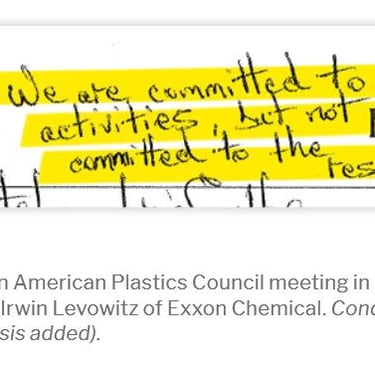
Evidence that the plastics industry has long known that recycling is bogus. Excerpt from https://climateintegrity.org/projects/plastics-fraud
Myth 13: There is nothing I can do…
Some people think ‘thirteen’ is unlucky. But we haven't found any proof for this. Some people say things like ‘things are the way they are. How can I change anything?' Or - 'It's too late to change now…'
So we want to take the opportunity to tell you that it’'s not all doom and gloom. Once we have dispelled these myths about recycling, we will be able to work much more quickly and effectively towards true solutions. We now know what doesn’t work – the industry-promoted idea that recycling plastics can positively impact the plastics crisis.


There are genuine pathways to better systems and materials that are not toxic. Many are old and traditional, or naturally sourced. Change can come very quickly. These changes can bring prosperity and vitality for many future generations to come.
But to work towards them, firstly we have to dispel what is perhaps the biggest myth of all - that plastic can be safely and effectively recycled. Failing to dispel this myth will leave us locked in to a toxic future.
Truth About Plastic volunteers